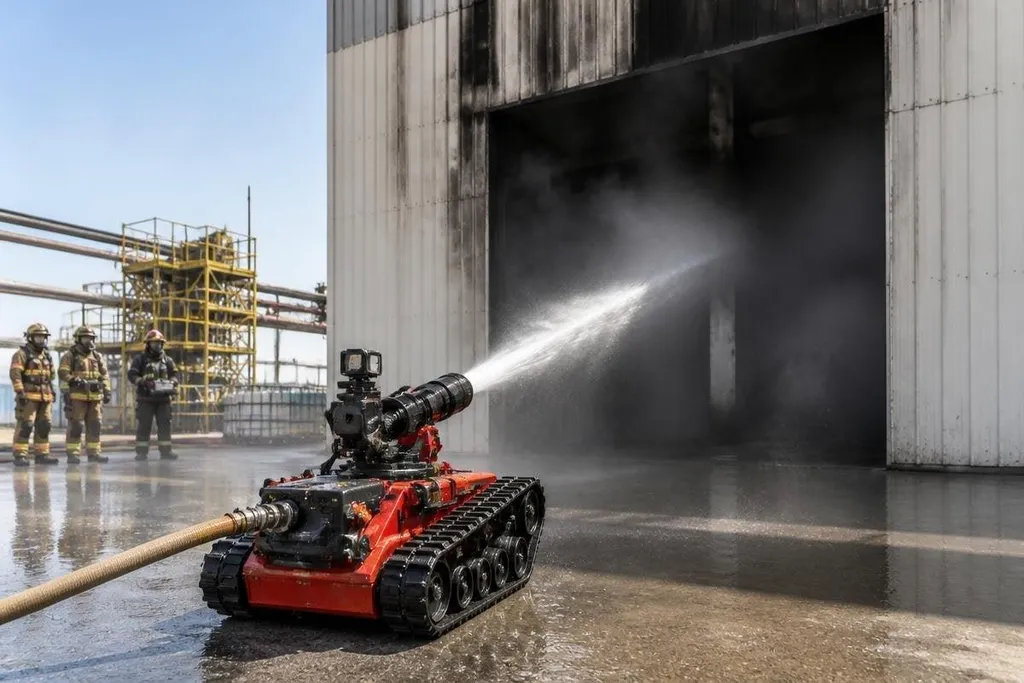
Firefighting robots can enter a burning building before a person does. A tracked chassis, thermal camera, water cannon, and remote control link let crews inspect heat and attack a fire from farther away.
That matters when smoke blocks vision, floors may fail, or stored materials burn too hot for protective clothing. The technology still has limits, but its role is moving from a remote curiosity toward a practical tool for specific calls.
- Remote entry: A crew can send the robot into a hot zone while operators stay outside.
- Fire attack: The water or foam line can work from a safer position.
- Useful data: Thermal images show heat that ordinary cameras cannot see.
What the robot does at a fire
Most firefighting robots are ground vehicles with tracks or large wheels. Tracks help the robot cross broken floors, hose lines, and loose material, while a low body can pass below some smoke and heat layers.
The operator controls the robot from a safe position. A camera shows the route ahead, and a thermal camera maps hot areas through smoke that would hide them from a normal video feed. The robot may also send back its temperature, battery state, and system warnings.
A mounted water cannon gives the crew another way to cool a room or slow a fire. Some systems can use foam, which helps when water alone is a poor fit, such as fires involving flammable liquids. The exact nozzle, pump, and hose setup depends on the robot and the fire service using it.
Why crews need more distance
A firefighter in protective gear can work close to heat, but the gear does not remove the danger. It adds weight, limits vision, and gives the person a fixed amount of time near the fire.
The robot changes that risk. The crew can inspect a structure before sending people inside, check a suspected hot spot after the main flames drop, or keep a water stream on a dangerous area while people handle evacuation and medical work.
The benefit depends on the job. It won't replace a firefighter who must search a room, carry a person, open a door by hand, or make a fast judgment inside a changing structure.
It can take on the part of the call that needs heat resistance and a steady stream of water.
Heat changes the test: a firefighting robot needs to keep moving, send video, and keep its water line working when smoke blocks its view. Robot24.com can connect those demands to named machines, field tests, and control systems before the next section looks at where the robots struggle.
Where the machines struggle
Fire scenes are poor places for wireless control. Concrete walls, metal structures, smoke, water, and damaged power systems can weaken the radio link. If the signal drops, the robot may stop, slow down, or need a tethered connection.
Heat also affects the machine. Motors, batteries, cameras, seals, and cables all have temperature limits. A thermal camera may show a hot area, but the operator still has to judge whether the floor can hold the robot and whether the route back remains open.
Water adds another problem. A hose can pull against the robot as pressure rises, especially when the vehicle turns or climbs. That force affects steering, battery use, and the operator's ability to keep the cannon aimed at the right place.
Training matters too. Crews need practice with the controller, camera views, hose behavior, charging routine, and recovery plan. A robot that stays in a truck because nobody has rehearsed its use won't help during a fire.
A buying checklist for fire services
Before a department chooses a machine, its team should check the tasks it expects the robot to handle:
- Route testing: Can it cross the doors, stairs, rubble, and hose lines found in local buildings?
- Heat limits: Which parts can stay near the fire, and for how long?
- Water setup: Does the pump use the department's hoses, fittings, and water supply?
- Control link: What happens when the radio signal weakens or disappears?
- Recovery plan: Can firefighters pull it back if a track breaks or the battery runs low?
- Crew training: How often will operators practice under smoke, noise, and low visibility?
The purchase price is only one part of the decision. Departments also need space for transport, battery charging, spare tracks, nozzle service, software updates, and training time. Those costs decide whether the robot becomes part of normal fire response or remains a machine for rare calls.
What happens next
Firefighting robots will earn wider use through repeated work, not dramatic demonstrations. Departments need records from real deployments: where the robot went, how long the control link held, how much water it moved, and what failed.
I'd choose a robot for a narrow job first, such as checking hot industrial spaces or attacking fires from outside a damaged building. That clear role gives crews a way to measure its value before they ask one machine to handle every part of a fire.